7th Annual INTERRUPT RACISM™ Summit
Monday, November 2, 2026, 8:30 AM - 4:30 PM EST
Meet the presenters
About the Summit
The 7th Annual INTERRUPT RACISM™ Summit is more than a gathering; it is a call to renewed resolve. In many traditions, the number seven represents completion and reflection, a time to take stock of what has been accomplished, what has been learned, and what must come next. This year’s theme, “We the People,” will highlight Rochester’s demonstrated progress in sustaining communities by leading with dignity, humanity, and a commitment to the common good.
We Are Excited to Announce Our 2026 Keynote Speaker!
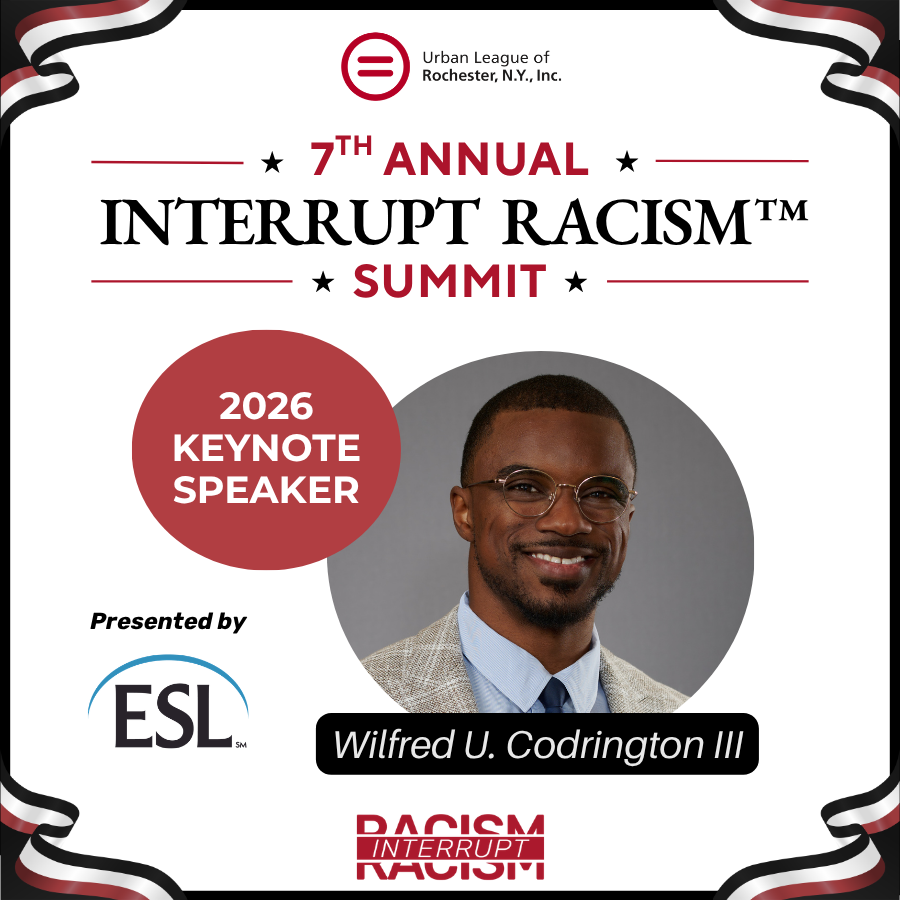
Wilfred Codrington III
We the [Nine] People?
Author of The People’s Constitution: 200 Years, 27 Amendments, and the Promise of a More Perfect Union and Walter Floersheimer Professor of Constitutional Law
-
Wilfred U. Codrington III is the Walter Floersheimer Professor of Constitutional Law and co-director of the Floersheimer Center for Constitutional Democracy at Cardozo School of Law. He is also a fellow at the Brennan Center for Justice at N.Y.U. School of Law. A leading public law expert, his research, teaching, and advocacy focus on voting, elections, and the law of democracy; constitutional law, including constitutional theory and reform; and civil rights, anti-discrimination, and the role of race in the law. Professor Codrington is the co-author of the 2021 book The People's Constitution: 200 Years, 27 Amendments, and the Promise of a More Perfect Union (New Press), a narrative history of amendments to the U.S. Constitution and call for a renewed popular commitment to progressive constitutional reform. His other scholarship appears or is forthcoming in several law reviews and journals, including the Columbia Law Review Forum, Harvard Law & Policy Review, Minnesota Law Review, N.Y.U. Law Review, and Washington & Lee Law Review, as well as in book chapters and other academic compilations. Codrington is a frequent commentator in national and international media, with essays and op-eds featured in outlets including The American Prospect, The Atlantic, The Hill, Politico, Slate, and U.S. News & World Report.
Prior to joining the Cardozo Law faculty in July 2024, Professor Codrington was an Associate Professor of Law and Dean's Research Scholar at Brooklyn Law School. He has also taught at Texas A&M School of Law and N.Y.U. Wagner School of Public Service. Before the legal academy, he was the inaugural Bernard and Anne Spitzer Fellow at the Brennan Center for Justice and a counsel in the Brennan Center's Democracy Program, a litigation associate at DLA Piper, a staffer for U.S. Congresswoman Eleanor Holmes Norton, and a law clerk for the Honorable Deborah Anne Batts, U.S. District Judge for the Southern District of New York. A first-generation college graduate, Codrington earned his undergraduate degree in philosophy from Brown University with honors, an MPA from the University of Pennsylvania, and a JD from Stanford Law School.
Morning Workshop Sessions
Session IA - 10:00 AM to 11:30 AM
-
This presentation will highlight key themes of the Claiming a Seat at the Table thought paper exploring how recent policy decisions are affecting quality of life in Monroe County.
Presenters: ROC Community Table
Location: Regency Ballroom A
-
This presentation will highlight the Urban League’s programs and community initiatives by uplifting the lived experiences of program participants in their own words.
Presenters: The Urban League of Rochester
Location: Regency Ballroom C
-
This presentation will highlight the progress of the Commission on Racial and Structural Equity (RASE) and engage participants in helping to advance recommendations and shape the next chapter of racial equity in Rochester.
Presenters: Commission on Racial and Structural Equity (RASE)
Location: Regency Ballroom B
Session IB - 10:00 AM to 10:55 AM
-
DEI initiatives often stall because they target only one layer of an organization, while racism operates across four layers simultaneously. This breakout session introduces Bolman and Deal's four-frame model—Structural, Human Resource, Political, and Symbolic—as a diagnostic lens for institutional change. Attendees will explore how inequity is embedded in policies, people practices, power dynamics, and organizational culture, grounded in real institutional patterns. Through an interactive diagnostic exercise, participants will identify where their organization's equity efforts are strongest and weakest, then leave with one concrete action step and a named person to hold them accountable.
Presenter: Markus Hunt Essien
Location: Frederick Douglass Room
-
Every institution decides what counts as evidence of intelligence, readiness, and leadership. Those decisions shape who receives opportunity, investment, and influence. This presentation examines how capable people are often overlooked because institutions recognize credentials more readily than demonstrated ability. Drawing from entrepreneurship, economic development, publishing, and community leadership, Tracy L. Williams introduces P.E.D.A.L. (Personal Evaluation, Development, and Leverage), a framework for identifying existing strengths before prescribing development. Participants will leave with practical tools to evaluate talent more accurately, reduce institutional blind spots, and build systems that connect demonstrated ability to opportunity, economic mobility, and lasting community impact.
Presenter: Tracy Williams
Location: Susan B. Anthony Room
-
Many teens and young adults carry pain they were never taught to name. In this interactive session, Coach Ivy Caldwell helps youth ages 16-21 build real language for what they feel and identify the generational patterns they inherited but never chose. Using her Name It to Tame It framework and a live Three-Step Reset practice, attendees learn the difference between reacting from an old wound and responding from solid ground. This is healing made practical, honest, and youth-led. Attendees leave with language for what they carry, one pattern they're ready to interrupt, and a tool they can use immediately.
Presenter: Ivy Caldwell
Location: Café on Main
Session IC - 11:05 AM to 12:00 PM
-
Being an ally is not an identity, it is a lifelong practice. Effective allies listen, learn, build authentic relationships, and use their influence to create opportunities for others. This interactive workshop helps participants explore what allyship looks like in everyday life by connecting it to their own values and purpose. Through guided reflection, storytelling, and small-group discussion, participants will develop a personal "Why Statement" that serves as the foundation for meaningful action. Attendees will leave with a personal plan to strengthen relationships, interrupt bias, and take one intentional step toward becoming a more effective ally in their communities and workplaces.
Presenters: Stephanie Campanelli & Laura Robinson
Location: Frederick Douglass Room
-
Although mental health and related terms (i.e. trauma) have become buzzwords, there is a general deficit in understanding the experiences of Black and marginalized people in America. To bridge the gap, this presentation will review theories of Black Psychology, Intersectionality, and Liberation Psychology. Participants will walk away with knowledge to enhance their individual, mental, emotional and spiritual well-being, as well as the ability to improve public health through collective action.
Presenter: Lamar the Therapist
Location: Susan B. Anthony Room
Afternoon Workshop Sessions
Session II - 2:00 PM to 2:55 PM
-
There was a time when my professionalism and expertise were questioned in a way that felt deeply disrespectful. I shared my lived experience, education, expertise, and it still wasn't enough! Many of us begin conversations with our defense already prepared. In this interactive session, we'll explore how racism, bias, and other lived experiences can shape what we believe we must prove before we deserve to be heard. Through reflection and courageous conversation, participants will put the defense down, reclaim and reveal their voices, and consider what it means to transirion from defending their value to taking up the spaces they were born to fill, with reminders and tools to reinforce that "We the People" get to sign our own permission slips with a “Clarity Shift to embodying confidence, voice and power.”
Presenters: Maisha Beard & Marquita Rugless
Location: Susan B. Anthony Room
-
Ever frozen when a colleague made a racist or harmful remark? You aren't alone. In this interactive introductory workshop at the Urban League’s Interrupt Racism Summit, we move past the silence. Participants will learn a culturally responsive protocol for addressing and interrupting harm, equipping you to respond more effectively and equitably when these situations arise. Together, we will analyze real-world scenarios through the lens of cultural responsiveness to inform and strengthen our collective approach. Leave this session with the actionable tools, confidence, and language needed to interrupt racism, call colleagues in, and foster a truly inclusive workplace.
Presenters: Jeanette Adams-Price, Syd Bell, Tay Porter-Jourdain, & Shane Wiegand
Location: Regency Ballroom A
-
The Minister Franklin D. Florence Civil Rights Heritage Site at Baden Park is a project honoring Rochester’s civil rights history and the legacy of Minister Franklin D. Florence. Located in Baden Park in Northeast Rochester, this space will serve as an educational and cultural landmark, inspiring future generations through stories of resilience, activism, and community strength. The City of Rochester and its project team have engaged with the community to gather ideas of how to add to the existing park amenities to best honor Rochester’s rich Civil Rights history. Utilizing public input, the team developed three master plan alternatives for public review and recommendations. Workshop attendees will learn more about the history of the Minister Franklin D. Florence Civil Rights Heritage Site @ Baden Park project, review the design alternatives for the park, and share their feedback to help guide the next phase of the project.
Presenters: Marlee Beers, Shawn Dunwoody, Art Hall, Jason Larsen, Sara Scott
Location: The Café on Main
-
Since 2021, the Indigenous Psychotherapy/Anti-Racist Culturally Competent Treatment (IP/ARCCT) certification has trained over 200 clinicians across Monroe County, relying on partnerships with health systems committed to training a critical mass of clinicians to drive systemic change. Participant evaluations are overwhelmingly positive, with clinicians describing lasting shifts in self-awareness and clinical practice. Early data show trained clinicians have lower no-show rates, reduced loss to contact, and longer therapeutic lengths of stay. Graduates join a learning collaborative for consultation, networking, and continued education, sustaining impact well beyond certification.
Presenters: Mike Boucher, Melanie Funchess, & Eve Hosford
Location: Regency Ballroom C
-
The session will explore how leaders can interrupt racism by shifting from punitive discipline toward a Progressive Support approach rooted in dignity, clarity, accountability, and compassion. Through reflection, real-world examples, and practical tools, participants will examine how bias can influence corrective practices and learn strategies for equitable coaching, feedback, and performance conversations that preserve humanity while maintaining standards.
Presenter: Jamie Warren
Location: Regency Ballroom B
-
NY has many noncompetitive elections and low participation rates. Under plurality votin, a person can win without majority support. Independents (about 30% of voters) cannot vote in primaries. Many voters can’t vote for their favorite candidate and have their vote impact the election. Most cities and towns use an at-large plurality system to choose municipal legislatures, a system disqualified as racist under the Voting Rights Act. Using ranked choice voting and all-access primaries could solve these problems. We will discuss proposed legislation in Rochester and statewide to strengthen our democracy.
Presenter: Barbara Grosh
Location: Frederick Douglass Room
Session III - 3:05 PM to 4:00 PM
-
This session equips executive leaders with the foundational language and tools of inclusive leadership. Participants will explore how positional power shapes culture, practice the concept of multi-partiality in real decision-making, and receive a clear framework for navigating missteps with accountability rather than defensiveness. Rather than treating inclusion as a compliance exercise, this session frames it as an organizational effectiveness practice which begins with clarifying the values that already anchor the work. Leaders will leave with one concrete, observable action to embed into their leadership practice immediately.
Presenter: Deborah Campbell
Location: Regency Ballroom B
-
Health equity work often stalls between good intentions and real change. Dr. Thomas Green draws on his doctoral research with Rochester community leaders, his Progress Arc framework, and more than three decades of executive and community leadership to walk participants through how equity initiatives actually move forward: from discovery and design to delivery and institutionalization. This session ties community voice to the practical mechanics of getting things done, including project management, staff alignment, and accountability for measurable outcomes. Participants will work through the framework using a real challenge from their own organization or community and leave with tools they can put to use right away.
Presenter: Dr. Thomas Green
Location: Regency Ballroom C
-
Every one of us inherits a story before we find our own voice. In this engaging and interactive session, author and speaker Leilanis Molina explores how culture, family, and lived experiences shape our confidence, leadership, and sense of belonging. Through heartfelt storytelling, humor, and practical reflection, participants will discover how to honor the values that shaped them while letting go of the beliefs that hold them back. Attendees will leave inspired and equipped with practical tools to communicate with courage, strengthen their communities, and embrace the power of their own voice.
Presenter: Leilanis Molina
Location: Frederick Douglass Room
-
The People We Must Become names the second erasure: the removal of Black authority, credibility, and consequence even where Black presence is celebrated. Moving through truth, grief, grace, and covenant, the session shows how institutions convert Black pain into managed discomfort, how good intentions substitute for changed conduct, and how easy unity flattens unequal responsibility. Drawing on my service as a military officer and the first Black Town Supervisor in Monroe County, it closes with a covenant of differentiated obligations: the harmed carry truth, power carries repair, beneficiaries spend capital, and witnesses enter the record. The wound first. The feelings second. The repair always.
Presenter: Lieutenant Colonel Andrae Evans
Location: Regency Ballroom A
-
Rochester’s racial homeownership gap was not created by accident. It grew from redlining, discriminatory lending, unequal investment, zoning decisions, and policies that helped some families build wealth while excluding others. Drawing from her work in real estate, housing advocacy, nonprofit leadership, local government, and a citywide political campaign, Niner Davis will connect Rochester’s housing history to present day barriers. Participants will examine homebuyer assistance, planning decisions, civic engagement, and the courage required to challenge systems. Attendees will leave prepared to use their voice, profession, and influence to expand opportunity one family and neighborhood at a time.
Presenter: Niner Davis
Location: Susan B. Anthony Room
Requests for proposals are closed.
-
Urban League of Rochester seeks proposals for presentations 55 minutes in length.
Presentations should align with one of the four tracks:
Structural Equity (Systems-level change)
Institutional Change (Organizational practices and procedures)
Personal Development (Individual growth and reflection)
Youth Voice (Ages 16 - 21)
Proposals must be submitted online. Submissions will be accepted through 11:59 PM EST on Friday, July 24, 2026.
-
Workshop/Presentation Details:
Title
Abstract (for promotional materials): <100 words
Learning Outcomes:
What are the learning outcomes of this workshop/presentation?
How will attendees apply what they have learned during your session? After your session?
How will you encourage active, participatory learning?
Resources:
Do you plan to recommend resources or suggest follow-ups to attendees? If so, what?
Do you hope to promote the sale of any items, including books, during your session? If so, what?
Ideal Audience for Session
Have you presented, or facilitated, on this topic in the past? If so, please list when, where, and, if available, provide a link to sample content.
Presenter Details (required for each presenter):
Name and contact information (E-mail address and Phone number)
Organization or affiliation (if applicable; unaffiliated individuals or groups are welcome to submit proposals)
Bio: <100 words in third person
Photo or headshot
Consent statement for use of image, likeness, or sample materials for promotional purposes.
-
Discounted ticket price for up to 2 presenters per presentation.
Preferred seating during the Legacy Luncheon and Keynote address.
Special recognition in program materials.
-
The INTERRUPT RACISM™ Summit team will review submissions, and all applicants will be notified of the status of their proposals by Friday, August 21, 2026.
Please submit any questions about the INTERRUPT RACISM™ Summit to the Urban League at interruptracism@ulr.org.